
"000 tons"
800 article(s) found

In February this year, Lampung Robbund exported 14321 tons of coffee beans with a total value of 28.8 million US dollars.
In February, Robusta exported 10, 4321 tons of coffee beans, with a total value of US $28.8 million. Ferynia, director of the Lampung Bureau of Trade, said that although the harvest had not yet begun, Lampung coffee continued to be exported to several countries. She said that according to the information of Lampung Industrial and Trade Cooperative, Lampong Robesda and Elaraby Arabika coffee beans have been exported to Europe and Asia.

Angola Fine Coffee Bean Flavor Description Grind Treatment Features Variety Producing Area Manor Planting Profile
In the 1970s, commercial coffee production in Angola was about 180,000 tons per year. Uige Province coffee cultivation area of 161,000 hectares, annual output of 99,550 tons, is the largest coffee cultivation

Angola Coffee Bean Price Flavor Description Grind Treatment Growing Environment Introduction
In the 1970s, commercial coffee production in Angola was about 180,000 tons per year. Uige Province coffee cultivation area of 161,000 hectares, annual output of 99,550 tons, is the largest coffee cultivation

Citrus flavor Ethiopian coffee grind characteristics Variety flavor description
In Ethiopia, coffee classification and quality control systems are divided into producer, regional and national levels. All coffees are inspected by local inspection agencies before they leave the country of origin, and then re-inspected at coffee inspection and grading centres in Addis and Diredova to determine their quality grade. Coffee is graded prior to auction and sale, and all participants in production, acquisition,

The unique aroma of Ethiopian Sidama Coffee Estate Introduction Ted Estate
Coffee is Ethiopia's most important export cash crop and the main source of foreign exchange earnings. Ethiopia's coffee exports account for about 3% of the world market share, making it the eighth largest coffee exporter in the world. Coffee exports increased steadily from 58,000 tons in 1990-1991 to 110,000 tons in 1995 - 1996 and remained at that level for the next few years. 2001 - 2002
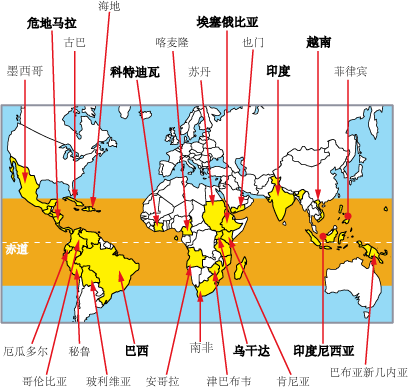
Vietnamese coffee is characterized by Japanese investment in Vietnamese coffee and French flavor.
Vietnam is a big producer today and a giant of tomorrow. Perhaps under the influence of French colonial rule, coffee grown in Vietnam has a French flavor. Arabica coffee was first brought to Vietnam by French missionaries. More than 400,000 coffee trees were introduced to Vietnam from 1865 to 1876 and were planted near Tonkin Bay, mostly Java or bourbon varieties. At present, the output of coffee in Vietnam is

Chinese Coffee Development Coffee drinking Chinese
No matter what kind of coffee, freshness is an important factor affecting the quality. When choosing and buying, grab one or two coffee beans and chew them in your mouth. If there is a clear sound, it means that the coffee beans are not damp, while the coffee beans with fragrant lips and teeth are the top grade, but it is best to pinch them with your hands and feel whether they are solid or not. Never buy empty-shell coffee. Freshly fried coffee beans are not suitable for immediate consumption.

Ethiopian coffee plantation flavor taste introduction Ethiopian coffee characteristics
35% of coffee is courtyard coffee. In this coffee garden, the planting is three-dimensional distribution. Coffee sits in the lower layers, in the shade of other crops, to get the right environment to grow. Fertilizer is mainly deciduous, withered grass and animal manure. 5% of coffee is plantation coffee. This is a modern way of growing coffee. Coffee is grown in forests, but new varieties are used and mixed with other trees.

Ethiopian Coffee Flavor description Grinding degree treatment Variety characteristics of Fine Coffee introduction
Ethiopia's coffee grading and quality control system has two main indicators: visual inspection and cup evaluation, including the color, cleanliness, origin, taste and characteristics of coffee beans. The export rating is marked by simple numbers, with the best washed coffee at level 5 and the best sun-cured coffee at level 4. After grading, mark the place of origin and then export. Usually the export is paid by letter of credit.

Ethiopian Coffee Flavor introduces the characteristics of Ethiopian Coffee
35% of the coffee is courtyard coffee. In this kind of coffee garden, the planting is three-dimensional. Coffee is located in the lower layer and gets a suitable growth environment in the shade of other crops. Fertilizers are mainly fallen leaves, withered grass and animal manure. 5% of the coffee belongs to plantation coffee. This is a modern way of growing coffee, which is also grown in forests, but uses new varieties and works with others.

The output is less than 200t, but the sales volume reaches 6000 tons. Xinglong Coffee is good after Premier Zhou Enlai Fuze.
Professional coffee knowledge exchange more coffee bean information please follow the coffee workshop (Wechat official account cafe_style)-our reporter Kuang Changxun Guo Jiaxuan special correspondent Chen Xunjing correspondent Wang Zhe Zhi Fu Ji, prosperity. In the Labour Day short holiday just past, Wan Ningxing

Yunnan coffee price replay "roller coaster" to seek pricing discourse is the foundation to break through.
As one of the main coffee producing areas in the world, the price of coffee in Yunnan is restricted by foreign markets and has no say in pricing. Experts believe that for growers and the industry as a whole, it is ultimately necessary to resist various risks through financial means and seek long-term development.

Distribution characteristics of Coffee growing areas in Yunnan, introduction of Yunnan Coffee
Following Cafe Review (official Wechat account vdailycom) found that Chinese Coffee has been growing for more than 100 years, but the coffee industry has been open for only 20 years. It is understood that the earliest coffee industry in China appeared in Hainan. Hainan's Lishen Coffee has built an annual production line with an annual output of 325 tons of instant powder, and more domestic three-in-one coffee brands are using power.
Philippine coffee prices may rise
According to a report in the Philippine Standard on July 2, the head of the Philippine Coffee Commission recently said that due to the expected decline in production and increased import demand, the price of coffee in the Philippines may rise, and the price of locally produced instant coffee is expected to increase by 5%. Non-instant coffee increased by 15%. The annual output of Philippine coffee reached 30, 000 tons at its peak, but the annual demand was 100000 tons, which is a traditional coffee.
Philippine Coffee prices rise
Recently, the head of the Philippine Coffee Commission said that due to the expected decline in production and increased import demand, the price of coffee in the Philippines is likely to rise. The price of locally produced instant coffee is expected to increase by 5% and that of non-instant coffee by 15%. The annual output of coffee in the Philippines reached 30, 000 tons at its peak, but the annual demand is 100000 tons. It is a traditional coffee importer and is expected to produce 26000 coffee this year.

"unsalable" Pu'er coffee beans
In April, the Yunnan coffee industry, which was shrouded by rumors of "unsalable coffee beans", once caused panic among farmers and the industry. However, statistics by the end of April showed that there were only 3000-4000 tons of Pu'er left in the main producing areas, including some coffee beans of poor quality.

Yemeni coffee features Yemeni coffee flavor
Coffee has been a traditional export product of Yemen for hundreds of years, and it is still one of the most important cash crops and export products of Yemen. Statistics show that among the top 30 exports of Yemen in 2000, cooked coffee beans, raw coffee beans and coffee shells ranked second, eighth and 21st respectively, with a total value of about $17.5 million, of which raw coffee was about $12.25 million.
Drought or "death of thirst" hidden worries of expansion behind the disorderly competition of ten thousand mu coffee in Baoshan, Yunnan Province
The continuing drought has hit the coffee industry in Baoshan, Yunnan Province, one of China's largest coffee producers. According to a survey data of Longyang District Hot work Station in Baoshan City, at present, only in Longyang District, the affected area of coffee has reached 66395 mu, and 16321 mu of coffee is facing no harvest. In addition to the impact of the drought, the low price of coffee also worries many farmers.
What are the coffee beans in Ethiopia's export single-product coffee market About African Coffee
Coffee is Ethiopia's most important export cash crop and the main source of foreign exchange earnings. Ethiopia's coffee exports account for about 3% of the world market share, making it the eighth largest coffee exporter in the world. Coffee exports increased steadily from 58,000 tons in 1990-1991 to 110,000 tons in 1995 - 1996 and remained at that level for the next few years. 2

Inhalable caffeine excess-inhalable caffeine energy bar
Inhalable caffeine excess-inhalable caffeine energy bars enter late March 2014, and coffee harvest is drawing to a close in the southern province of Manning, Sumatra, which accounts for more than 99% of China's coffee acreage and production. Under the influence of the international market, after more than two years of cold winter, the purchase price of coffee beans soared in 2014, from 13 yuan per kilogram to 2.